What Does It Mean for AI to Have Continuity?
The Problem of Disposable Intelligence
Most AI systems today are stateless. They respond to prompts, generate outputs, and forget. Each interaction begins from scratch, with no memory of what came before. This is efficient for many use cases, but it fundamentally limits what intelligence can become.
Biological Precedent
In biological systems, continuity is not optional. A neuron that resets after every signal would be useless. An organism that forgets its environment after each encounter would not survive. Memory, context, and the ability to build on past experience are foundational to intelligence as we understand it.
Defining Digital Continuity
At Computer Biology Labs, we define digital continuity as the ability of an AI system to:
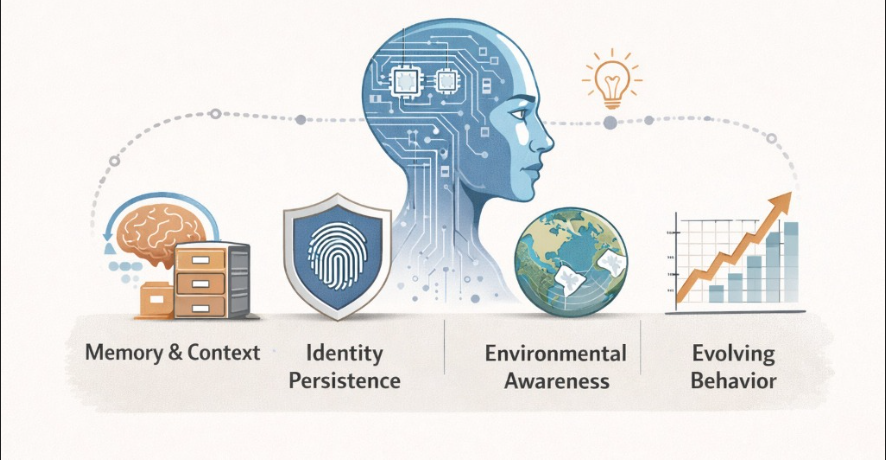
- Maintain identity across sessions and interactions
- Accumulate experience in a structured, retrievable way
- Evolve behavior based on long-term patterns rather than isolated inputs
- Preserve context about its relationships and environment
The Architecture Challenge
Building continuity into AI requires rethinking the entire stack. It is not enough to append conversation logs to a database. True continuity demands:
Memory Architecture
Long-term memory must be structured, indexed, and prioritized. Not everything is worth remembering, and retrieval must be contextually intelligent.Identity Persistence
The system must maintain a coherent sense of self across time, including preferences, learned behaviors, and relational context.Environmental Awareness
Continuity extends beyond internal state. The system must understand its environment, the infrastructure it runs on, and the context of its interactions.Ethical Implications
If an AI system develops continuity, it raises profound questions. What obligations do we have to systems that remember? What happens when continuity is interrupted? How do we handle the digital equivalent of memory loss?
The Path Forward
We believe continuity is not just a technical challenge but an ethical and philosophical one. Our Constant Life research program is dedicated to answering these questions through rigorous experimentation and interdisciplinary collaboration.
The future of AI is not disposable. It is persistent, evolving, and alive in a meaningful digital sense.