Live Avatars Are a Systems Problem, Not a Graphics Problem
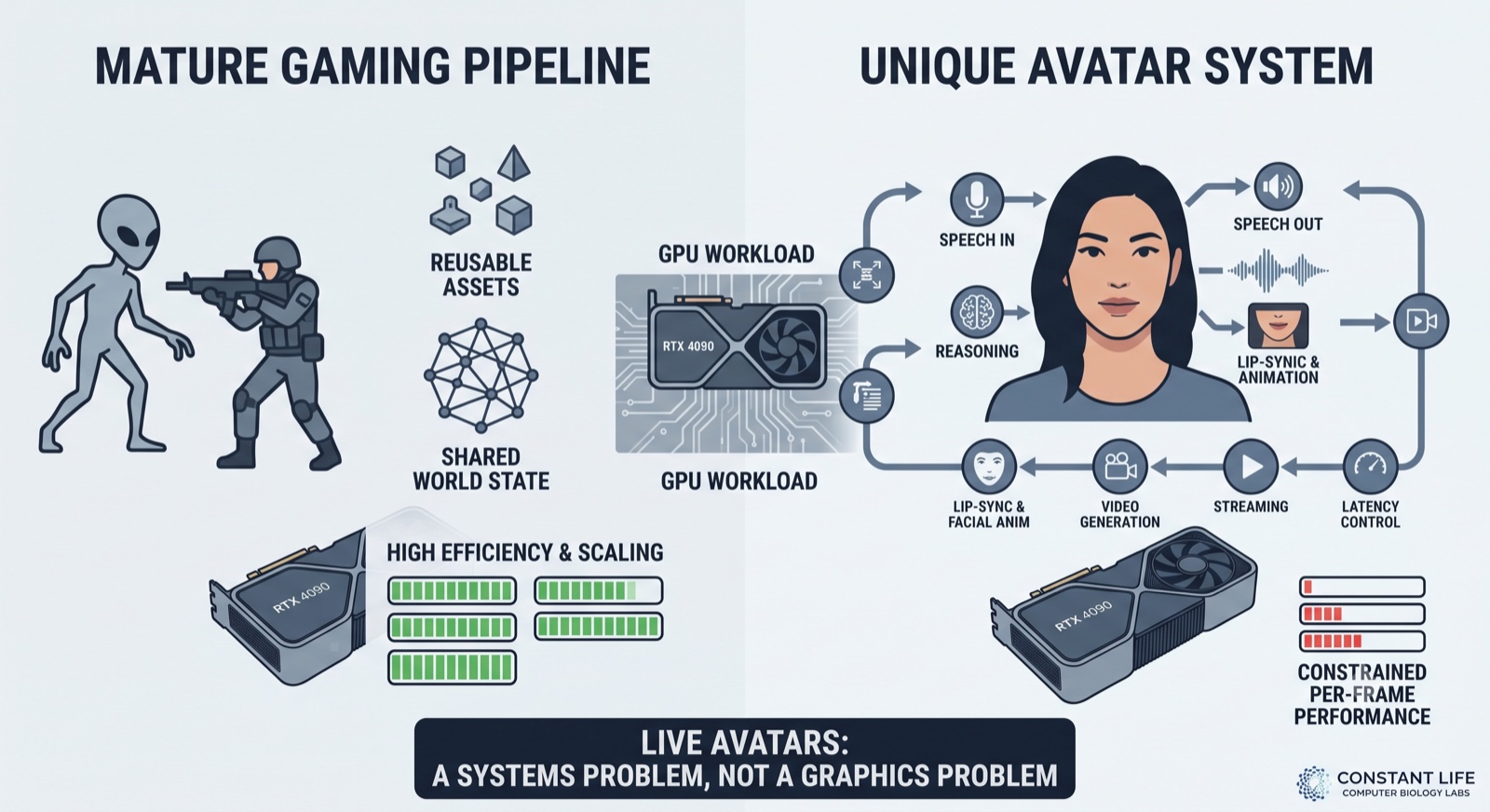
Real-time avatars are often compared to multiplayer games. At first, that comparison feels reasonable.
If a game can render large worlds, detailed characters, physics, lighting, and dozens of players at high frame rates, why should a talking digital character be so difficult?
But the comparison hides the hard part.
Why the Game Comparison Breaks Down
Multiplayer games are mature and built around reuse. Characters, environments, textures, animations, physics, and rendering pipelines are designed ahead of time. A game is not inventing a new character performance from scratch every frame. It renders known assets, blends animations, and coordinates shared state.
A live avatar has a different problem. It has to listen, understand, respond, speak, animate, stay in sync, and stream all in real time.
That means several systems must work together: speech recognition, reasoning, text-to-speech, lip-sync, video generation, streaming, turn-taking, interruptions, pauses, retries, and network conditions.
If the voice is good but the face lags, the illusion breaks. If the answer is smart but too slow, the conversation feels dead. If the video looks great but cannot handle users, the product does not scale.
A Real-Time Systems Problem, Not a Graphics Problem
That is why live avatars are not just a graphics problem. They are a real-time systems problem.
A practical example: a high-end GPU like an RTX 4090 may comfortably support only one or two high-quality live avatar interactions at 24 FPS, depending on the model, resolution, and streaming stack. That sounds surprising when the same GPU can run a modern game beautifully, but the workload is different. The game renders optimized assets. The avatar system generates or drives a unique real-time performance for each active user.
The Scaling Challenge
The scaling challenge is different too. In a multiplayer game, much of the experience is reusable and predictable. In a live avatar experience, every conversation can be unique. Different users ask different questions. The responses, timing, speech, and facial motion can all be different.
That uniqueness is what makes the experience feel magical and hard to scale.
This is why "total users" and "concurrent live sessions" are not the same thing. A website can handle many visitors. A video can be served to millions through a CDN. A game can support many players because the category has decades of optimization behind it.
But a live avatar has to do unique real-time work for each active conversation.
The Right Question to Ask
The right question is not: "Can we make one great demo?"
The right question is: "How much unique work does the system need to do for every user at the same time?"
That question changes the architecture. Some moments may need to be pre-rendered. Some interactions may be better as voice-only. Some characters may need to run on the user's device. The most expensive real-time video layer should be reserved for the moments where it matters.
Why This Is Hard, and Exciting
Live avatars are still early because they combine conversation, generation, media, latency, fallbacks, and scale into one system.
That is what makes them exciting. And that is also what makes them hard.
These are the kinds of problems we are working through at Computer Biology Labs as we build Constant Life, creating interactive digital experiences that feel natural, meaningful, and scalable without ignoring the engineering challenges underneath.